
Trieste
another day, another merchant metropolis in decline

After Venice Trieste is impossibly spacious. Wide wind-scoured streets, cold sunlight racing through them. Grand, proper buildings, topped with cornices and balustrades and other words of pomposity, taking up three times the amount of square footage as any Venetian palazzo. You can feel that this is the edge of Italy, that for hundreds of years it wasn’t Italy at all but under Hapsburg protection. The grandeur is the grandeur of Austria-Hungary: regimented, bureaucratic, vast.
The spaciousness isn’t only architectural. In Venice I ignored the people as much as possible, treating the crowds as an obstacle to weave through or around, part of the scenery and none of my business. In Trieste it feels like there are hardly any people to avoid. This isn’t true—the grand square (largest seaside square in Europe, the girl at the hostel tells me) is full of people waiting to enter the century-old cafe, and tourists wandering to the edge of the shining, uninviting water. On other streets people move in and out of shops, drink hot wine from the last stalls of the Christmas markets, come out of the grocery store laden with bags. Trieste is a place where people live. Still. It feels empty.
In the 1600s, Trieste was a town huddled on a windy seaside, hoping that Venice wouldn’t invade (again). In the 1700s, the Hapsburg Empress Maria Theresa began expanding the town with an eye toward the future, until it was conquered by Napoleon like everybody else. But in the 1800s, Trieste was tapped to be the main port of the Austro-Hungarian empire. It was molded purposefully, carefully, with all the Hapsburg attention to ceremony, into a crucial point of trade between east and west. It became known as the “third entrance to the Suez Canal.” And then, along with its empire, it died.
“A great city that has lost its purpose is like a specialist in retirement,” writes Jan Morris in Trieste and the Meaning of Nowhere. “He potters around the house. He tinkers with this hobby or that…But he knows that the real energy of his life, the fascination of his calling that has driven him with so much satisfaction for so many years, is never going to be resumed.”
~
Trieste makes me dredge deeper mythologies. There’s the Hapsburg eagle on a crest, and the ubiquitous European angels, bare-breasted women and triumphant soldiers—but there, in the wrought iron of a balcony, is something stranger. Tail of a fish, forelegs of a horse, torso of a man. It takes me a moment to remember its name, and in that time the whole city shines in before me like something spit up by the sea. Hapsburg-ruled, Balkan by proximity, Italian by language and, if we’re honest, Italian by anti-Yugoslav feeling on the part of the Allies. Forget them all. Trieste has always been closer to the sea than to anything else. The balcony is full of ichthyocentaurs, often personifications of foam and the abyss.
~
The coffee houses, however, are Viennese. Arched ceilings, polished wood, tasteful gilt, cream dusted with cinnamon. The food is half Venetian (spritzes, pasta), half Bavarian. Lunch is a sandwich Dad would have loved: slices of soft sweet ham, shorn from the hock in front of me; shavings of fragrant horseradish so fresh it’s nutty and hardly burns; and some truly excellent bitter mustard.
~
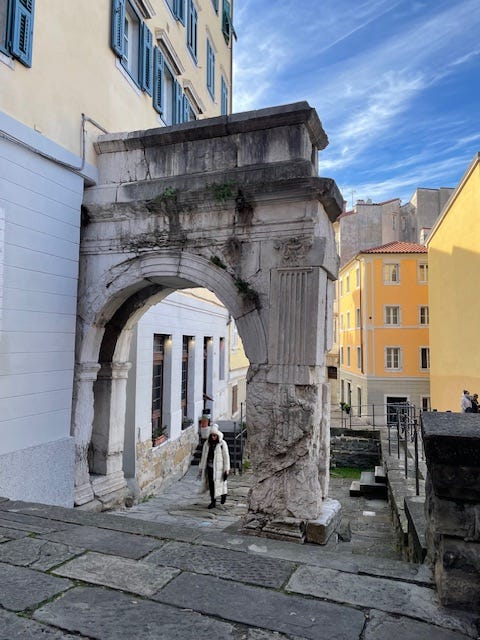
At sea level, then, Trieste is Hapsburg. Up the hill, in the old town by the castle, it is something else, Italianate and medieval and left-handed.
~
Walking up to the old Jewish quarter at night. There was a small ghetto here, as in nearly every city in Europe, though most of Trieste’s Jews, for the century and a half they were allowed to live unmolested, lived outside the ghetto’s walls in the city proper. I stumble on their synagogue after leaving the Caffe San Marco, where I have just finished my Viennese coffee and which a hundred years ago served kosher food. It is so large, the synagogue, and so obviously Jewish, that it genuinely startles me. Synagogues in Europe don’t look like this; no matter how beautiful on the inside, they tend to hunch on the outside, trying not to be ostentatious, pretending to be less than they are. Not this one. It seems to take up the whole street, and even the outer walls are carved with Hebrew.
Trieste is also home to the only extermination camp on Italian soil, and what was once the ghetto is a tangle of wine bars and cafes. They are my destination, but before I reach them, I turn a corner and a Roman amphitheater rears up. Ranks of seats rising in a half-moon, massive fallen blocks of carved stone. On the grassy stage, two pillars lie at perfect angles, in a V that doesn’t quite touch. The amphitheater might be flanked by modern buildings and a parking garage, but in that first moment it feels as massive and shocking as the synagogue did earlier, and the stands are likewise full of ghosts.
Behind me rushes a group of tourists. One of them says in English, “What this? Roman? Huh!”
They fly on. Beyond the left wall of the amphitheater Orion, glittering, throws himself headfirst into the black sky.
~
Next day I discover the tourists’ reaction might have been more appropriate than mine; it really is a very small amphitheater, not well-preserved. And it’s not like the Romans made this town what it was. To be impressed by Trieste’s past one should most likely go to the customs house.
~
Sunny and cold, clear enough to see straight across the Adriatic. Italy curves here like a huge hand, Trieste the thumb, Venice the tip of the forefinger, bare hills on the web of flesh between them. Mountains where knuckles should be, the blue of distance, snow-flecked, wavering in the pale air. Between us on the flat navy sea are five container ships and two sailboats. The container ships are at anchor, perfectly still and haphazardly arranged. The sailboats weave around them, slowly and silently. Trieste maintains a feeling of suspension, of being out of time, though the cars on the road behind me move as fast and as loudly as ever.
~
The city did have a resurgence, post Austria-Hungary, as a major trading post: it’s where Slovenian youth would come to buy blue jeans and rock albums to smuggle back into Yugoslavia.
~
Spent the afternoon wrestling jaggedly with emotion, despite my best intentions, and declined my hostel-mate’s invitation to dinner in favor of being alone. Apparently Trieste has this effect, too. The city “appears to have a particular influence upon those of us with a weakness for allegory,” Jan Morris writes. “That is to say, as the Austrian Robert Musil once put it, those of us who suppose everything to mean more than it has any honest claim to mean.”
Or maybe Morris and I are both just prone to a nice evening of wallowing.
~
Castle of San Giusto, crest of the high hill. When the Hapsburgs built this castle—flat ramparts, one round battery, modestly impressive—in the 16th century, the ground was higher. Fifteen hundred years of sediment and human living had piled up on the remains of the old Roman town, the walls that Octavian built, and the old forum was completely buried. So the Hapsburgs built on top of it. They had their stucco eagle stamped over the fortress doorway in a nod to antiquity, and the road to that door ran right over the buried forum, and they never even knew it was there.
Oh Alice, It is such a joy to travel the Silk Road alongside you. Thank you for your gorgeous writing, and adventurous spirit. Loving you from NJ.
" A weakness for allegory." Sounds about right.